
Food LicenseOnline in India
Published By e-startup | Update on: 12-April-2026 09:09:24 AM | 10 Minutes Read
Food License starting at ₹1000 within 7 to 15 days. A food license is necessary in India to ensure food safety and quality. It helps to build consumer trust and expand all type of food business activity involved.
Simple & Fast Food License Process
Show Your Interest on WhatsApp
Click the WhatsApp icon and start a quick chat with our expert team.
Send Your Documents
Share your business documents via WhatsApp or email. 100% online, no paperwork.
Make Your Payment
Make a secure online payment to begin the certification process.
Get Your License
Receive your Food License via email/WhatsApp within 15 working days.
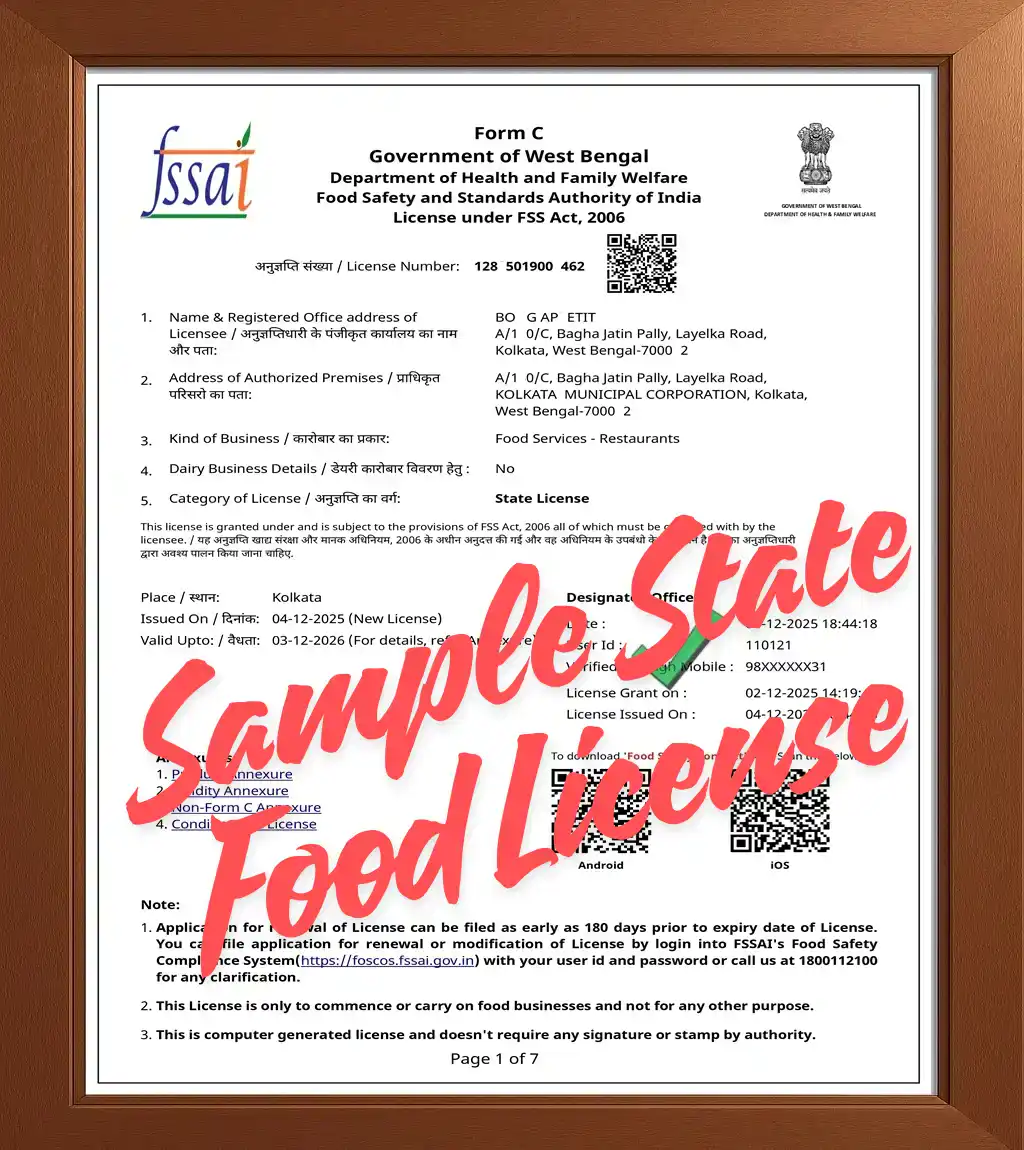

Sample Food License (FSSAI)
✅ Fast Govt Approval
✅ Expert Documentation Support
✅ Hassle-Free Process
✅ Trusted by 5,000+ Businesses
✅ 4.9★ Rated 126+ Reviews
🔍 Overview of Food License Registration in India
In India, a Food license is required for any individual or entity that is involved in food-related activities such as manufacturing, processing, packaging, distribution, and sale of food products. The food license is issued under the Food Safety and Standards Act, 2006, which is a comprehensive law that regulates food safety and hygiene standards in the country.
 Issuing Authority in India
FSSAI is a statutory body established under the Food Safety and Standards Act, 2006, and it functions under the Ministry of Health & Family Welfare, Government of India.
 Types of FSSAI Registration
The food license is classified into three categories, namely: (FSSAI Notification 01/04/2026 Onwards.)
Basic Registration: This is for small-scale food businesses having a turnover upto Rs. 1.5 crores.
State License: This is required for medium-sized food businesses having a annual turnover more than Rs. 1.5 crores to 50 crores. It is issued by the State Government where the business is located.
Central License: This is required for large-sized food businesses that have an annual turnover of more than Rs. 50 crores. It is issued by the Central Government through the FSSAI.
The food license application process involves filling out an application form, providing necessary documents such as proof of identity, address, and the type of food business, and paying the requisite fee. The license is issued within 15 days of the application.
 Who Needs Food License?
In India, any person or business involved in handling food at any stage must obtain an FSSAI Food License or Registration. This is mandatory under the Food Safety and Standards Act, 2006.:
-
Food Manufacturers & Processors: Food manufacturing units, Packaged food producers, Dairy units, milk chilling centers, Slaughterhouses, meat & poultry processing units
-
Food Sellers & Traders: Retail food shops, Wholesalers & distributors, Supermarkets & departmental stores
-
Food Service Providers: Restaurants, cafés, food courts, Sweet shops & bakeries, Hotels, resorts, guest houses, Caterers cloud kitchens & home kitchens
-
Food Transport & Storage: Food transporters, Cold storage & warehouses, Godowns handling food items
-
Online & Special Categories: Online food delivery platforms (Zomato, Swiggy, etc.), E-commerce food sellers, Importers & exporters of food products, Food business operators at airports, seaports, railways
-
Small & Home-Based Food Businesses: Home bakers, Homemade pickle, papad, spice makers, Street food vendors & hawkers
 Documents Required for Food License
Common documents include:
Proprietorship
1) Photo of Proprietor.
2) PAN Card of Proprietor.
3) Aadhar Card of Proprietor.
4) Legal Occupancy of Principal place of Business Property Tax Receipt, ROR copy, Electric bill
5) Trade License.
6) Water Test Report.(For State and Central License)
Partnership
1) PAN Card of Firm & Partners.
2) Aadhar Card of Partners.
3) Legal Occupancy of Principal place of Business Property Tax Receipt, ROR copy, Electric bill
4) Trade License
5) Water Test Report (For State and Central License)
6) Deed of Partnership
Public Limited/ Private Limited
1) PAN card of Company & Directors
2) Aadhar Card of Directors
3) Legal Occupancy of Principal place of Business Property Tax Receipt, ROR copy, Electric bill.
4) Trade License
5) Incorporation Certificate
6) MOA And AOA
7) Water Test Report (For State and Central License)
 Benefits of Food License
Food license registration in India offers several benefits to food businesses, some of which are:
Food license registration ensures that the food business complies with the legal requirements.
It helps to maintain food safety and hygiene standards and reduces the risk of penalties or fines.
Food license registration helps to build consumer trust
Food license registration is essential for businesses that wish to expand their operations to other states or countries.
It is a mandatory requirement for obtaining import-export licenses.
Food license registration improves the marketability of the food products as it assures consumers.
It also opens up opportunities to supply to large retail chains and government institutions.
Food license registration helps to create a positive brand image for the food business.
In summary, food license registration is essential for any food business in India as it ensures compliance with the legal requirements, builds consumer trust, improves marketability, and provides access to various government schemes and subsidies.
 Procedure for Food License Registration
Here's a step-by-step procedure for Food License or FSSAI registration in India:
-
Sign up on the FoSCoS Portal
-
Login to your account
-
Click to “Apply for New License/Registration” button.
-
Select the premise of operation “General”, “Railway Station” or “Airport/Seaport”
-
Choose the State where License/Registration will be obtained.
-
Choose Manufacturing, Trade/Retail, Food Service, or Central Govt. Agency from the group of business types.
-
Select any one of the Multiple Selection can be made from each group.
-
Click on the Proceed button.
-
Fill Registration Certificate Details such as applicant details, address of premises, contact details
-
Select years you want to apply from one to five years.
-
Attach the necessary documents
-
The last step is to pay the requisite fee for the food license
-
After completing the above steps, submit the application
 How Long It Takes to Get a Food License in India?
-
The food license will be issued within 15 working days after successful application and document submission. The process is quick, hassle-free, and fully digital through the official portal.
 Govt. Fees for Food License
| Category | Eligibility | Govt. Fees | Our Fees |
|---|---|---|---|
| FSSAI Basic Registration | Turnover up to Rs. 12 lakhs | Fee of Rs.100/-. | Processing Fees Rs.1000/- |
| FSSAI State License | Turnover Rs. 12 lakhs to Rs. 20 crores. | Fee between Rs.2,500/- to Rs.5,000/- | Processing Fees Rs.1000/- |
| FSSAI Central License | Turnover of more than Rs. 20 crores. | Fee of Rs.7,500/- | Processing Fees Rs.1000/- |
 Validity and Renewal
-
Generally valid for 1 year.
-
Must be renewed annually before expiry to avoid penalties.
 Penalties for Non-Compliance
-
Operating a food business without an FSSAI license is illegal and can attract penalties up to ₹5 lakh and imprisonment.
-
The sale of misbranded products is punishable with a fine of up to ₹3 lakh.
-
The production, processing, or storage of food using unethical and unhealthy practices is punishable with a fine of up to ₹1 lakh.
-
A penalty of up to ₹5 lakh may also be imposed if a person suffers due to low-quality food.
 Frequently Asked Questions
- Basic FSSAI Registration – For small businesses
- State FSSAI License – For medium-sized businesses
- Central FSSAI License – For large businesses and importers/exporters
- PAN Card of Proprietor/Partners/Directors
- Aadhar Card of Proprietor/Partners/Directors
- Property Tax Receipt
- Trade License
- Water Test Report [Sources-3]

Success Stories & Reviews

Arpit Thakur
Chartered AccountantBest service provider Very fast service Very polite in nature Most important thing is that trustworthy Go for this guys.

Sk Maksud
BusinessmanVery hard working. As per their commitment certificate gives within 1 day. They have work at 1:34AM due to server was not working full day. Great Job.

Dev singh
AccountantHad a great experience delivered on time. Punctual and committed thank you very much.

Prasanth P Kumar
Administrative OfficerVery fast registration and cooperative dealing

Avijit Das
AccountantThanks ! Certificate received less than 24hrs. Great job done.

Rituraj Buragohain
BusinessmanVery happy with there service and with quick response. My work done with a day. I really appreciate your dedication.

Book Manier
BuisnessmanI greatly appreciate the sincere service. I will continue my contact with your firm. Thanking you.

Ramesh Kolte
BusinessmanTreated respectfully with prompt service
Why Do Customers Love Us?

Registered by
A Govt. of India registered firm you can trust for secure, authentic, and professional services.

Security score A+
Browse with confidence—our A+ security rating keeps your data safe, private, and fully protected.
OnTime Service
Experience on-time service with fast execution, reliable assistance, and efficient solutions for your business needs.

Happy Customer
5000+ happy customers, one goal—helping your business stay healthy, compliant, and ready for growth.

Risk-Free Guarantee
Our risk-free guarantee ensures safe, transparent, and hassle-free services with 100% customer satisfaction.

Customer Reviews
Read genuine verified customer reviews to discover real experiences, trusted feedback, and reliable insights before choosing our services.
Our Trusted Partner