How Our GST Registration Assistance Works
Tell Us What You Need
Tell our team about your business and the type of GST Registration help you need.
Share Your Details
Share the required business and identity details through the agreed communication channel.
Complete the Service
If you choose professional assistance, complete the service payment before the application work begins.
Receive Your GST Certificate
After successful registration, the GST Registration Certificate is issued online by the government portal.


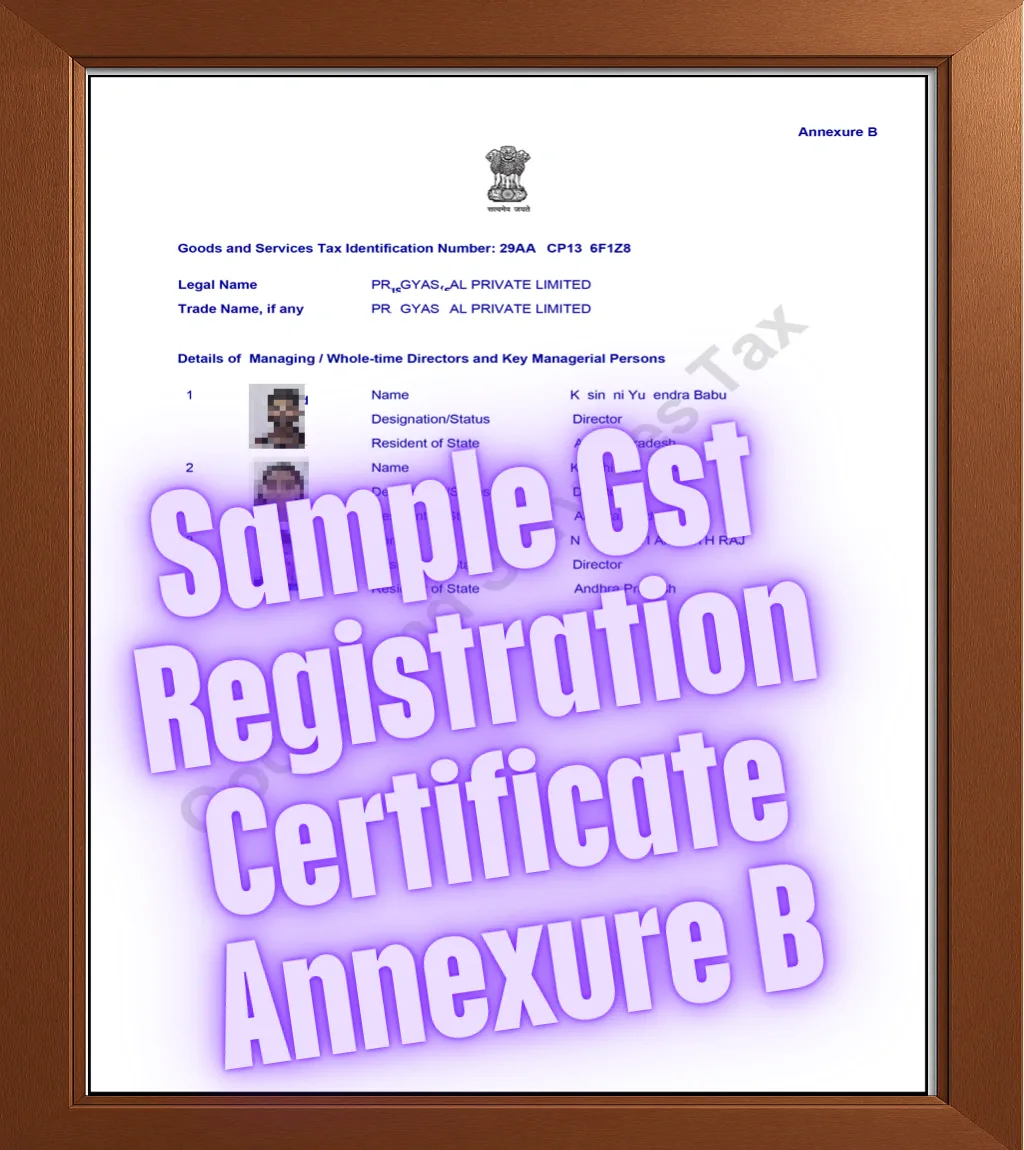
Sample GST Registration Certificate
✔ Fast Govt Approval
✔ Expert Documentation Support
✔ Hassle-Free Process
✔ End-to-end consultancy support
✔ Quick and fast processing
 Overview of GST Registration in India
The Goods and Services Tax (GST), implemented on 1st July 2017, is considered the biggest tax reform in independent India. By replacing a complex web of indirect taxes such as VAT, excise duty, and service tax, GST introduced the concept of “One Nation, One Tax”. Its aim was to simplify the tax system, increase transparency, reduce cascading effects of multiple taxes, and create a unified national market.
Turnover Criteria
- For Goods: Businesses with an annual turnover exceeding ₹40 lakh (₹20 lakh for special category states).
- For Services: Businesses with an annual turnover exceeding ₹20 lakh (₹10 lakh for special category states).
Key Characteristics of GST:
- Single tax system replacing multiple indirect taxes.
- Dual structure – levied by both the Centre (CGST) and States (SGST) for intra-state supply.
- Integrated GST (IGST) for inter-state supply and imports.
- Input Tax Credit (ITC) mechanism reduces tax-on-tax (cascading effect).
- Multiple rate slabs (0%, 5%, 18%, and 40%).
 Issuing Authority of GST in India
The Goods and Services Tax (GST) in India is administered and regulated by the Goods and Services Tax Council (GST Council) at the policy-making level and implemented by the Central Board of Indirect Taxes and Customs (CBIC) along with respective State GST departments.
 Types of GST in India
- CGST (Central GST): Levied by the Central Government on intra-state supply.
- SGST (State GST): Levied by State Governments on intra-state supply.
- IGST (Integrated GST): Levied by the Central Government on inter-state supply and imports.
- UTGST (Union Territory GST): Levied on supplies in Union Territories without legislatures.
 Process of GST Registration
- Visit the GST Portal – www.gst.gov.in
- Fill the GST REG-01 Form – Provide PAN, mobile number, and email for OTP verification.
- Submit Business Details – Enter business name, address, and type of registration.
- Upload Documents – Attach required documents as per the business type.
- Receive Application Reference Number (ARN) – Track the application status using ARN.
- Verification by GST Officer – If required, additional documents may be requested.
- GSTIN Issued – Once approved, a 15-digit GST Identification Number (GSTIN) is provided.
 Processing Time for GST Registration in India
The time taken for GST registration depends on the accuracy of documents and the verification process by the tax authorities. Generally, the process may take up to 1 working day.
 Documents Required for GST Registration
Check list of Documents Required For GST Registration
| Proprietorship | Partnership | Public Limited/ Private Limited |
| 1) Photo of the Proprietor. | 1) Photo of the Partners. | 1) Photo of the Directors |
| 2) PAN Card of Proprietor. | 2) PAN Card of Firm & Partners. | 2) PAN card of Company & Directors |
| 3) Aadhar Card of Proprietor. | 3) Aadhar Card of Partners. | 3) Aadhar Card of Directors |
| 4) Office address proof, Electricity Bill and Property Tax Receipt. | 4) Office address proof, Electricity Bill and Property Tax Receipt. | 4) Office address proof, Electricity Bill and Property Tax Receipt. |
| 5) Bank Certificate /Cancelled Cheque | 5) Bank Certificate /Cancelled Cheque | 5) Bank Certificate /Cancelled Cheque |
| 6) Any Licence of Business | 6) Any Licence of Business |
6) Certificate of Incorporation |
 Major Benefits of GST Registration
- Legally Compliant – Avoids penalties and ensures smooth business operations.
- Input Tax Credit (ITC) – Allows businesses to claim tax credit on purchases.
- Wider Market Access – Essential for B2B transactions and interstate trade.
- E-Commerce Participation – Mandatory for selling on platforms like Amazon, Flipkart, etc.
- Enhances Business Credibility – Registered businesses gain trust among customers and suppliers.
 GST Penalty for Non-Compliance
- Failure to Register: ₹10,000 or 10% of the tax due (whichever is higher).
- Deliberate Tax Evasion: 100% of the tax due.
- Late Filing: ₹50 per day (₹20 for NIL returns).
- Fraudulent GST Claims: Heavy penalties and possible legal actions.
 Impact of GST on the Indian Economy
- Boost to GDP: Studies estimate a 1-2% GDP growth in the long term.
- Ease of Doing Business: India jumped in World Bank rankings post-GST.
- E-commerce growth: Unified tax system supported digital trade.
- Formalization of economy: More businesses came under the tax net.
 Evolution of GST in India
Before GST, India’s taxation system was highly fragmented. Each state levied its own Value Added Tax (VAT), while the Centre levied excise duty and service tax. This led to multiple compliance issues and high costs for businesses.
- 2000: Vajpayee government set up a committee to draft GST.
- 2006: GST was proposed by Finance Minister P. Chidambaram.
- 2011: Constitution Amendment Bill introduced in Parliament.
- 2014: The bill was reintroduced by the Modi government.
- 2016: The GST Bill was passed in Parliament.
- 2017: GST was officially launched on 1st July 2017.
GST Law, Rules & News Updates
Access important GST Rules, amendments and notifications issued by the Government of India, CBIC and GST Council. These official documents are provided for taxpayer reference and compliance purposes.
 Frequently Asked Questions About GST Registration
GST registration is mandatory for:
- Businesses with turnover above the applicable threshold limit.
- Interstate suppliers where compulsory registration rules apply.
- E-commerce sellers and aggregators where registration is required.
- Businesses liable under reverse charge mechanism (RCM). [Sources-1]
- PAN card of the applicant/business, as applicable.
- Aadhaar card of the proprietor, partners, directors or authorised signatory, as applicable.
- Photographs where required.
- Business registration/incorporation proof.
- Principal place of business proof such as rent agreement, electricity bill, property document or NOC, as applicable. [Sources-2]